
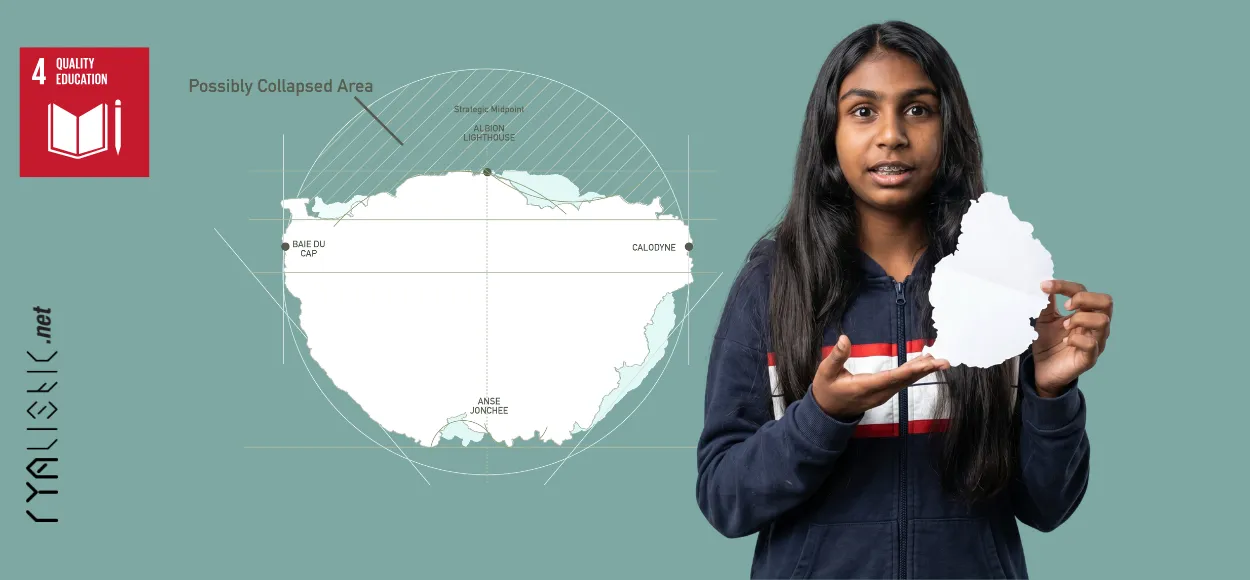
Ever since I was small, I would stare at maps of Mauritius and feel like something was a bit "off". If you look at our coastline, the north, east, and south curve in a nice, relatively uniform way. But the west side? It looks flat and jagged, like someone took a giant bite out of the island.
Whenever I mentioned this to my friends or family, they would laugh and say I was imagining things. But when I visited the Mauritius Oceanography Institute, I discovered that my intuition wasn't crazy after all!
Scientists like Mrs. Rohinee Bhiwajee explained to me that the western flank of the massive shield volcano that originally formed Mauritius actually collapsed into the sea millions of years ago. The missing piece of the circle is lying deep on the ocean floor!
Our Search for Patterns
This whole discovery made me think about how we construct our expectations of the world. Why did I expect the island to be circular or symmetrical in the first place? And why does it feel satisfying to know that it used to be symmetrical?
In Mathematics and Natural Sciences, we are trained to search for symmetry. Symmetrical shapes are easier for our brains to process, so we often assume nature should default to symmetry. Through intuition and sense perception, our minds constantly try to impose order on a chaotic world. When a pattern is broken—like the missing west coast of Mauritius—our brain flags it as an anomaly.
This raises an interesting question: does symmetry actually exist as a fundamental law of nature, or is it just a cognitive tool that humans invent to make the universe easier to understand?
Rya